A note in 5 layers
Wet-into-wet: finishing in one sitting
Wet-into-wet is not a looser version of layered painting. It is a different economy: you trade drying time for the right to change any edge at any moment, and you pay for it with the certainty that nothing stays where you put it.
- Section
- Method
- Support
- Oil
- Drying
- 单次 3–5 小时,中途不干
- Published
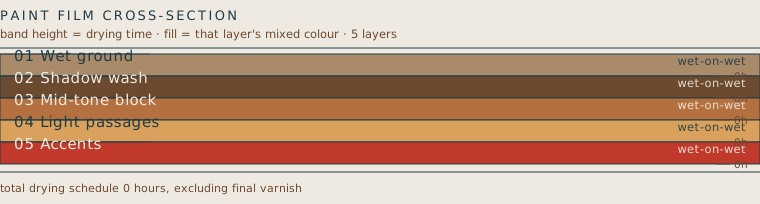
Working order in one session
Rub the whole panel with a thin transparent earth tone and keep it wet. Lay every shadow shape next, in one pass, and leave them. The mid-tones go down third and are merged into the shadow edges with a clean dry brush — this is where the form is actually modelled.
Lights go on last and get one pass each. A loaded brush laid once reads as light; the same brush laid three times reads as a smudge, because by the third stroke you are lifting the colour you just put down.
Managing the clock
Add alkyd medium to slow nothing but to accelerate the final set — it will not extend an oil's , and thinking it does is the most common cause of a session that collapses at hour five. If you want a longer window, use a slower-drying oil such as safflower or poppy, not more medium.
Plan the session in blocks: ninety minutes for the shadow structure, ninety for mid-tones, sixty for lights, thirty for accents. When a block runs over, abandon the remainder of that block rather than eating into the next.
What this method teaches you
forces you to commit to a value before you have evidence, which is the actual skill the layered method hides. Four hours of wet-into-wet per week for a month will do more for your judgement of tone than a year of careful glazing.
The finished surface also keeps a record: because nothing was buried, the drawing, the corrections and the hesitation are all still visible. That is a feature. Buyers and teachers both read those marks as evidence of decision-making.
One-session timetable
| Block | Minutes | Work | Tool |
|---|---|---|---|
| Wet the panel | 10 | Transparent earth tone, whole surface | Large flat |
| Shadow structure | 80 | All darks, one pass, no rework | No. 8 filbert |
| Mid-tones | 90 | Merge into shadows, separate forms | No. 6 round |
| Lights | 60 | One pass per light shape | No. 10 flat |
| Accents | 30 | Saturated touches, tube paint | No. 2 rigger |
Layer schedule
| # | Layer | Technique | Mix | Dry |
|---|---|---|---|---|
| 1 | Wet ground | Raw sienna rubbed over the whole panel, still wet | #A98B6A | 0 h |
| 2 | Shadow wash | Umber plus ultramarine, laid wet and left alone | #6B4A2F | 0 h |
| 3 | Mid-tone block | Merged into shadow edges with a clean dry brush | #B4713F | 0 h |
| 4 | Light passages | Loaded brush, one pass, never reworked | #D9A15B | 0 h |
| 5 | Accents | Last twenty minutes, straight from the tube | #C0392B | 0 h |
Questions that come up
- How do I stop the colours turning to mud?
- Two rules: never brush across a passage more than three times, and mix the next value on the palette instead of on the canvas. Mud comes from the canvas becoming the mixing surface.
- Is alla prima only for sketches?
- No. Sargent's finished portraits and most of Manet's major works are single-session paintings. What they have in common is a decided drawing before the first mark, not a loose one.
Materials and safety note
Drying times assume a ventilated studio at 20 °C and 50 % relative humidity; cold or damp conditions extend them substantially. Solvents and metal-bearing pigments (lead white, cadmiums, cobalts) belong in a ventilated space, out of prolonged skin contact, and lead-bearing paint does not belong on anything a child handles. This page is craft information, not materials-safety, health or conservation advice.