A note in 5 layers
Three-pass glazing: building depth without mud
Most mud on a beginner's canvas is not a pigment problem. It comes from three passes applied at the same thickness and the same opacity, so the picture only gets darker instead of deeper. The three-pass method fixes that by giving each pass a different job.
- Section
- Method
- Support
- Oil
- Drying
- 20 °C 下每层间隔 18–24 小时
- Published
What each pass is actually for
Pass one is drawing and value: one earth pigment, no white, lights wiped back with a rag. Pass two is the , where the whole light-dark range is compressed into a single hue. Pass three is chroma — thin, transparent, and deliberately kept away from the lights you already like.
If you can see all three jobs happening at once you are working too wet. The reliable test is to photograph the canvas in greyscale after pass two. If the greyscale image already reads as a finished picture, the value structure is sound and the can only add to it.
Mixing the glaze so it behaves
A working is roughly one part paint to three or four parts medium, mixed on the palette until it looks like weak tea on a knife edge. It should dry to a film you can barely see held at an angle, and it should not hold a brushstroke: if the edge of your stroke stays crisp after ten seconds, add medium.
Brush it on with a soft square, then finish with light vertical strokes in one direction so the film evens out. Never scrub back into a that has begun to set — that is where streaks come from.
Where mud comes from, and the fix
A half-dry layer is the trap. Oil paint goes through a stage roughly six to twelve hours in where the surface has skinned but the film beneath is still soft; a brush then lifts rather than covers, and the lifted pigment mixes with the new colour on the canvas rather than on the palette.
The fix is sequencing, not technique. Either wait for full touch-dry, or commit to wet-into-wet and finish the passage in one sitting. If a passage has already gone grey, let it dry, then lift the haze back with a very thin of the original hue rather than repainting it opaquely.
Pass schedule for a 40 × 50 cm canvas
| Pass | Film | Medium | Wait before next |
|---|---|---|---|
| 1 — block-in | Thin, matte | Turpentine, 1:2 | 12 h |
| 2 — dead-colour | Lean, matte | Turpentine + 1 drop linseed | 20–24 h |
| 3 — glazes | Fat, glossy | Linseed or alkyd 1:4 | 24 h per glaze |
| 4 — accents | Opaque | Tube paint, no medium | — |
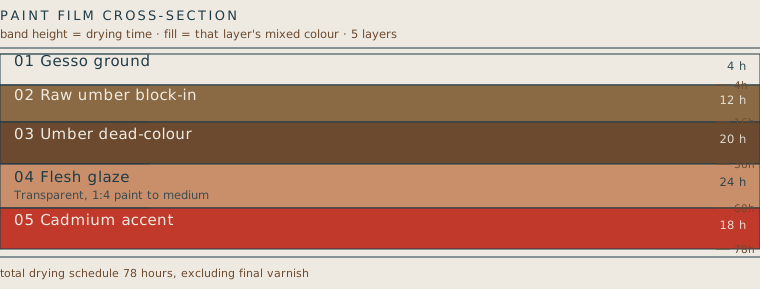
Layer schedule
| # | Layer | Technique | Mix | Dry |
|---|---|---|---|---|
| 1 | Gesso ground | Two coats acrylic gesso, sanded 400-grit | #EFEAE1 | 4 h |
| 2 | Raw umber block-in | Thin washes, no white, wiped lights | #8A6A45 | 12 h |
| 3 | Umber dead-colour | Full value range in one earth tone | #6B4A2F | 20 h |
| 4 | Flesh glaze | Transparent, 1:4 paint to medium | #C98F6B | 24 h |
| 5 | Cadmium accent | Opaque touches at the very end | #C0392B | 18 h |
Questions that come up
- How long must pass two dry before the glaze goes on?
- Long enough that a clean fingertip pressed on the surface leaves no tack and no print — usually 18–24 hours for a umber pass thinned with turpentine at 20 °C, and closer to 36 hours in a cold room. If the surface still smells strongly of solvent, the film is not ready.
- Can I glaze with acrylic instead?
- Yes, but the working window is minutes rather than hours, and an acrylic glaze dries slightly cloudy unless you use a gloss medium. See the acrylic glazing entry for the wet-blend method that suits a fast film.
Materials and safety note
Drying times assume a ventilated studio at 20 °C and 50 % relative humidity; cold or damp conditions extend them substantially. Solvents and metal-bearing pigments (lead white, cadmiums, cobalts) belong in a ventilated space, out of prolonged skin contact, and lead-bearing paint does not belong on anything a child handles. This page is craft information, not materials-safety, health or conservation advice.