A note in 5 layers
Fat over lean, explained without the folklore
The rule is usually repeated as a slogan, which makes it easy to obey and hard to use. Stated properly: an oil film cures by oxidation, and a film that cures faster also shrinks and stiffens faster. Put that film on top of a slower, more elastic one and the tension goes the wrong way.
- Section
- Method
- Support
- Oil
- Drying
- 20 °C 下膜完全固化需 6–10 天
- Published
The mechanism in one paragraph
Linseed oil cross-links with atmospheric oxygen over days to years. Extra oil means more cross-linking sites and a longer, more gradual cure, so the finished film keeps some give. Solvent does not cross-link at all — it simply leaves, and the pigment-and-binder film left behind is thinner, denser and stiffer.
Cracks appear when a stiff top film cannot follow the movement of the layer under it, whether that movement is slow cure shrinkage or a canvas that expands with humidity. on top means the top film is the brittle one, right where the eye will see the damage.
Counting oil in practice
Build a ladder and write it on the stretcher. Layer 1: pigment plus odourless mineral spirits, no oil. Layer 2: same mix with one drop of linseed per 10 ml. Layer 3: two to three drops per 10 ml. Layer 4: a medium of linseed and stand oil, no solvent at all.
The trap is that most tube colours already contain oil, and some contain a lot. A stiff earth like raw umber is comparatively ; a soft, glossy cadmium straight from the tube is already fattish. Judge by what you add, and keep the additions monotonic.
When the rule does not apply
Alla prima painting finished wet-into-wet in one session has no layers in the curing sense, so the rule is irrelevant. The same goes for a picture built entirely from alkyd medium, where every film cures at roughly the same rate.
What does not work is flipping the ladder halfway up because a passage is fighting you. If a passage needs reworking after a layer has gone on, sand it back to a clean surface first, seal with a thin alkyd, and treat the repair as its own mini-ladder.
Oil ladder written on the stretcher
| Layer | Oil added per 10 ml | Solvent | Relative flexibility |
|---|---|---|---|
| 1 | 0 drops | OMS as needed | Lowest |
| 2 | 1 drop linseed | OMS as needed | Low |
| 3 | 3 drops linseed | OMS sparingly | Medium |
| 4 | Linseed + stand oil | None | Highest |
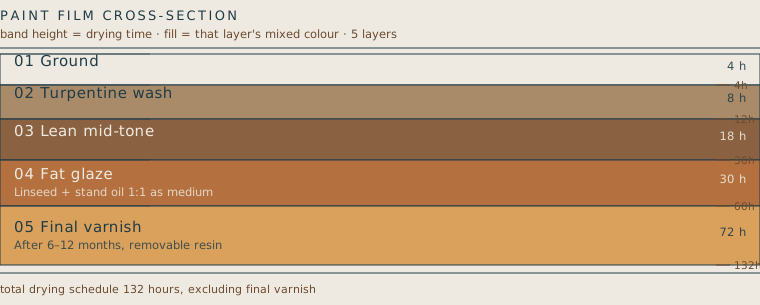
Layer schedule
| # | Layer | Technique | Mix | Dry |
|---|---|---|---|---|
| 1 | Ground | Acrylic gesso — no oil at all | #EFEAE1 | 4 h |
| 2 | Turpentine wash | Pigment + solvent only, 0 % oil | #A98B6A | 8 h |
| 3 | Lean mid-tone | One drop linseed per 10 ml | #8A6242 | 18 h |
| 4 | Fat glaze | Linseed + stand oil 1:1 as medium | #B4713F | 30 h |
| 5 | Final varnish | After 6–12 months, removable resin | #D9A15B | 72 h |
Questions that come up
- Is 'fat over lean' about oil percentage or about drying speed?
- Both, and they usually agree. Adding oil slows the cure and leaves a more flexible film; adding solvent speeds the cure and leaves a more brittle one. Count oil, not consistency — a buttery tube colour straight from the tube is not automatically 'fat'.
- Where does alkyd fit?
- Alkyd resins behave like a fat layer for flexibility but cure far faster than linseed. Treat an alkyd-added layer as the fat side of the comparison, and do not follow it with a pure solvent-thinned layer.
Materials and safety note
Drying times assume a ventilated studio at 20 °C and 50 % relative humidity; cold or damp conditions extend them substantially. Solvents and metal-bearing pigments (lead white, cadmiums, cobalts) belong in a ventilated space, out of prolonged skin contact, and lead-bearing paint does not belong on anything a child handles. This page is craft information, not materials-safety, health or conservation advice.