A note in 4 layers
Linseed oil vs stand oil: choosing the right body
Both come from flax. The difference is what heat and oxygen do to the oil before it reaches your palette, and that difference decides whether a glaze levels into a mirror or holds every brush hair's track.
- Section
- Medium
- Support
- Oil
- Drying
- 亚麻仁油 24 小时;熟油 3–4 天
- Published
What heat does to the molecule
Raw and linseed are mixtures of triglyceride molecules that cross-link only after they meet oxygen on the canvas. has already been held at around 250–300 °C without air, so its chains have partially joined. The result is roughly ten times the viscosity with none of the added drying speed.
That pre-joining is why levels: the long chains slide over each other and settle flat before oxidation locks the film. It is also why it dries slowly — many of the reaction sites are already used up.
Mixing proportions that work
For a general glazing medium, start with five parts odourless mineral spirits, three parts linseed oil and one part . That dries overnight, levels well and stays workable for about four hours in a sealed palette.
For the last pass, invert it: four parts , one part OMS, no linseed. This is the mix that gives the enamel-smooth surface associated with Dutch still life. Add a drop of cobalt drier only if the room is below 18 °C — with , over-dosing drier causes wrinkling.
Reading the film a week later
A linseed-rich film stays slightly open for days, which is friendly for reworking but collects dust. A stand-oil-rich film skins over faster than it dries through, so it feels dry while the layer below is still soft — do not rework it, and do not varnish it early.
Label your medium jar with the ratio and the date. When a passage has gone wrong three weeks later, the jar label is the only reliable record of what is actually on the canvas.
Choosing by job
| Job | Use | Ratio | Dry to touch |
|---|---|---|---|
| Block-in | OMS only | — | 4–6 h |
| General glaze | Linseed + OMS | 3 : 5 | 18–24 h |
| Final glaze | Stand oil + OMS | 4 : 1 | 3–4 days |
| Opaque impasto | Tube paint, no medium | — | 2–4 days |
Layer schedule
| # | Layer | Technique | Mix | Dry |
|---|---|---|---|---|
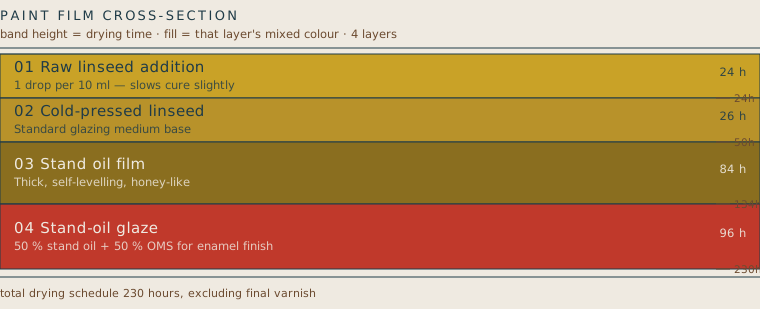
| 1 | Raw linseed addition | 1 drop per 10 ml — slows cure slightly | #C9A227 | 24 h |
| 2 | Cold-pressed linseed | Standard glazing medium base | #B8922A | 26 h |
| 3 | Stand oil film | Thick, self-levelling, honey-like | #8A6E1F | 84 h |
| 4 | Stand-oil glaze | 50 % stand oil + 50 % OMS for enamel finish | #C0392B | 96 h |
Questions that come up
- Can I use stand oil for the whole painting?
- Not in one sitting. Pure stand oil stays tacky for two to three days, which makes wet-into-wet work impossible and forces you into a strict layer-by-layer schedule. Most painters use it only in the last fat glazes.
- Does stand oil cause yellowing?
- Less than cold-pressed linseed, and far less than poppy oil. Yellowing is worst in dark, damp storage; a picture kept in daylight and re-varnished every few decades will show almost none.
Materials and safety note
Drying times assume a ventilated studio at 20 °C and 50 % relative humidity; cold or damp conditions extend them substantially. Solvents and metal-bearing pigments (lead white, cadmiums, cobalts) belong in a ventilated space, out of prolonged skin contact, and lead-bearing paint does not belong on anything a child handles. This page is craft information, not materials-safety, health or conservation advice.