A note in 6 layers
Copying Vermeer: the glaze stack in The Milkmaid
Stand in front of the Milkmaid and the first surprise is how little paint there is. The lead white is thin, the blues are thin, and the famous light comes from a stack of films each doing one job.
- Section
- Copy
- Support
- Oil
- Drying
- 复原层次需要 9–12 天干燥
- Published
What the surface actually shows
The wall behind the figure is not one colour. It is a warm grey modelled with white and umber, then cooled with a thin glaze, which is why the shadow behind the window has warmth in it while the light wall reads cold. Mixing that final colour directly in one pass flattens it immediately.
Look at the bread and the milk stream. Both are almost pure lead white with a minimum of vehicle, applied at the very end over dry layers. The white is not painted white — it is the only place the original ground is allowed back through.
Rebuilding the apron blue
The apron is the exercise worth copying. Start with the monochrome umber drawing, carry the value range as far as it will go in earth alone, then bring in a cool grey with lead white so the mid-tones are already slightly blue-grey before any blue pigment arrives.
The ultramarine goes on as a glaze at roughly one part pigment to four parts medium, thinned so that the brush leaves no drag. Two thin passes are better than one heavy one; in the shadow folds the blue is laid over the warm underpainting rather than next to it, which is why the darks still look luminous.
The order that matters
Two rules survive from this picture. First, the coolest and most saturated colour goes on last and thinnest. Second, no highlight is painted until every shadow around it is finished — the milk stream is believable because the shadow under the jug was resolved first.
If you keep only one habit from a Vermeer study, keep the final overall wipe: a single warm glaze over the whole surface, then a clean rag drawn across the highest lights. It is the cheapest way to make a student painting look like it belongs to the same century.
Copy schedule for a 30 × 25 cm study
| Session | Work | Medium | Drying |
|---|---|---|---|
| 1 | Tone ground, block shadow shapes | OMS + umber | overnight |
| 2 | Dead-colour, whole value range | Lead white + umber | 30 h |
| 3 | Apron and jacket darks | Ultramarine glaze 1:4 | 30 h |
| 4 | Bodice reds, table cover | Vermilion glaze | 24 h |
| 5 | Highlights, final satin glaze | Thick white + linseed | — |
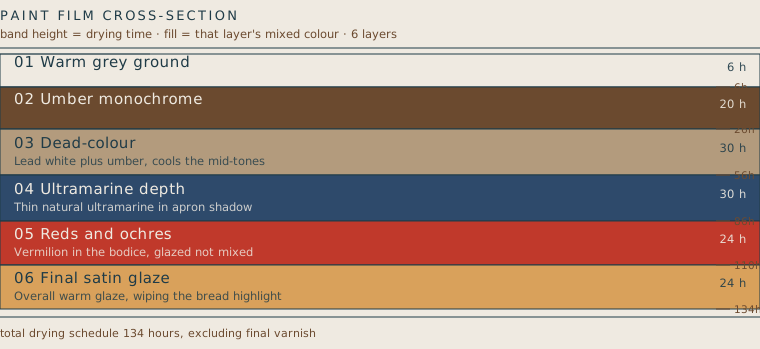
Layer schedule
| # | Layer | Technique | Mix | Dry |
|---|---|---|---|---|
| 1 | Warm grey ground | Chalk-glue ground, ochre-toned | #EFEAE1 | 6 h |
| 2 | Umber monochrome | Full drawing in earth pigment, no white | #6B4A2F | 20 h |
| 3 | Dead-colour | Lead white plus umber, cools the mid-tones | #B39B7D | 30 h |
| 4 | Ultramarine depth | Thin natural ultramarine in apron shadow | #2E4A6B | 30 h |
| 5 | Reds and ochres | Vermilion in the bodice, glazed not mixed | #C0392B | 24 h |
| 6 | Final satin glaze | Overall warm glaze, wiping the bread highlight | #D9A15B | 24 h |
Questions that come up
- Was Vermeer using a camera obscura?
- The optical evidence — small circles of confusion in the highlights, slightly flattened perspective in the interiors — is consistent with it, and the 2017–2020 examination of the Milkmaid's underpainting showed a simpler, bolder structure than the finished surface suggests. Whatever the tool, the layer order is conventional.
- What should a copyist not do?
- Do not try to match the surface in one pass. Almost every failure in a Vermeer copy comes from mixing the final greyish-blue wall colour rather than building it from a warm grey with a cool glaze over it.
Materials and safety note
Drying times assume a ventilated studio at 20 °C and 50 % relative humidity; cold or damp conditions extend them substantially. Solvents and metal-bearing pigments (lead white, cadmiums, cobalts) belong in a ventilated space, out of prolonged skin contact, and lead-bearing paint does not belong on anything a child handles. This page is craft information, not materials-safety, health or conservation advice.